
Biden wants 45% of US electricity to come from solar power by 2050. An energy tech expert breaks down what it would take.
Biden wants 45% of US electricity to come from solar power by 2050. An energy tech expert breaks down what it would take.
 Admin
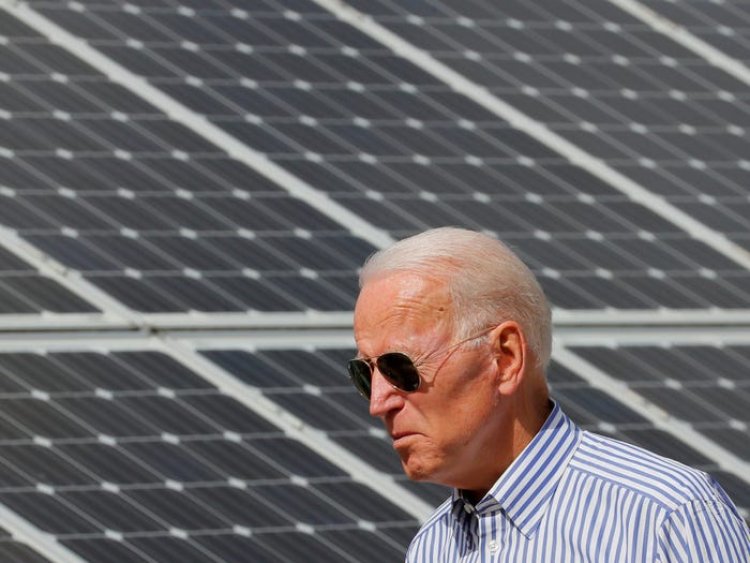

President Biden said investing in clean energy will help combat climate change and create new jobs. Brian Snyder/Reuters
President Biden announced a new plan to reduce carbon emissions by investing in clean energy.
The White House report says solar power could provide almost half of the US electricity supply by 2050.
President Joe Biden has called for major clean energy investments as a way to curb climate change and generate jobs. On Sept. 8, 2021, the White House released a report produced by the US Department of Energy that found that solar power could generate up to 45% of the US electricity supply by 2050, compared to less than 4% today. We asked Joshua D. Rhodes, an energy technology and policy researcher at the University of Texas at Austin, what it would take to meet this target.
Why such a heavy focus on solar power? Doesn't a low-carbon future require many types of clean energy?
The Energy Department's Solar Futures Study lays out three future pathways for the US grid: business as usual; decarbonization, meaning a massive shift to low-carbon and carbon-free energy sources; and decarbonization with economy-wide electrification of activities that are powered now by fossil fuels.
It concludes that the latter two scenarios would require approximately 1,050-1,570 gigawatts of solar power, which would meet about 44% to 45% of expected electricity demand in 2050. For perspective, one gigawatt of generating capacity is equivalent to about 3.1 million solar panels or 364 large-scale wind turbines.
The rest would come mostly from a mix of other low- or zero-carbon sources, including wind, nuclear, hydropower, biopower, geothermal and combustion turbines run on zero-carbon synthetic fuels such as hydrogen. Energy storage capacity — systems such as large installations of high-capacity batteries — would also expand at roughly the same rate as solar.
One advantage solar power has over many other low-carbon technologies is that most of the US has lots of sunshine. Wind, hydropower, and geothermal resources aren't so evenly distributed: There are large zones where these resources are poor or nonexistent.
Relying more heavily on region-specific technologies would mean developing them extremely densely where they are most abundant. It also would require building more high-voltage transmission lines to move that energy over long distances, which could increase costs and draw opposition from landowners.
Source: INSIDER