
Why Are Businesses Moving From Traditional Chatbots to Agentic AI Chatbot Development?
Businesses are moving beyond basic chatbots to agentic AI that can understand context, use tools, automate tasks, and deliver smarter customer experiences.
 Laura Bennett
Traditional chatbots gave businesses a fast way to automate basic conversations. But as customer requests grow more complex, these bots often struggle to understand intent, maintain context, or complete tasks beyond predefined workflows.
That gap is changing how companies approach AI chatbot development. Instead of building bots that only respond, businesses are investing in agentic AI chatbot development: chatbots that can reason, use business tools, and take action. This article explains why the shift is happening and what to consider before building one.

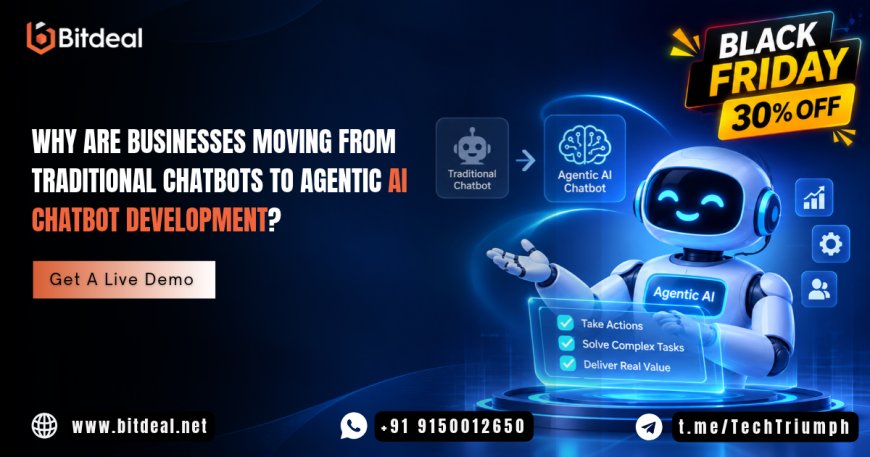
Why Are Businesses Moving Beyond Traditional Chatbots?
Customer expectations have changed. People want fast, accurate, and personalized support, not scripted replies that send them in circles. Rule-based chatbots depend on keywords and fixed flows, so when a user rephrases a question or adds a follow-up, the conversation often breaks down. The result is repeated questions, incorrect answers, and frustrated customers asking for a human agent.
The deeper limitation is that most traditional bots only share information. They can explain how to reset a password, but they can’t do it for the user. Businesses now want intelligent AI chatbot solutions that resolve issues end to end, and that is where agentic AI chatbots stand out.
How Is Agentic AI Changing AI Chatbot Development?
Agentic AI shifts the goal of AI chatbot development from simple conversation to goal-driven execution. A traditional chatbot understands a request and responds. An agentic AI chatbot understands the request, reasons about what is needed, uses the right tools, takes action, and verifies the result.
This is made possible by modern LLM-powered chatbots, which interpret meaning rather than just keywords. With the right AI chatbot integration across CRMs, payment systems, and internal databases, they can fetch real-time information and update records. A single conversation can verify a customer’s identity, check their account, process a request, and send a confirmation, with no manual handoff.
Key Features of Agentic AI Chatbots
Context and Memory
Agentic chatbots retain earlier parts of the conversation and, where permitted, past interactions. This allows personalized responses without forcing users to repeat themselves.
Planning and Task Execution
Agentic AI chatbots break complex requests into smaller steps, determine which tools are needed, and execute tasks in sequence. This lets them handle workflows that go well beyond simple question-and-answer interactions.
RAG and Business Knowledge
RAG-based chatbots use Retrieval-Augmented Generation (RAG) to pull information from your documents, FAQs, and policies. This helps ground responses in your business information and can reduce irrelevant or unsupported responses.
Tool and API Integration
By connecting with existing software through APIs and tools, the chatbot can book appointments, update orders, create tickets, or trigger workflows across your technology stack.
Human-in-the-Loop
Not every decision should be automated. Human-in-the-loop controls let the chatbot escalate sensitive or complex cases to a person, keeping quality and compliance in check.
Business Use Cases of Agentic AI Chatbots
Customer Support and Issue Resolution
Agentic chatbots handle common requests, retrieve account details, and resolve issues without agent involvement, so support teams can focus on higher-priority cases.
Sales and Lead Qualification
They engage website visitors, ask qualifying questions, and pass high-intent leads to sales teams with full conversation context.
Fintech Onboarding and Assistance
In fintech, they guide users through onboarding, explain product features, and collect required information within security and compliance requirements.
Internal Workflow Automation
Businesses also use them internally for HR queries, IT support, report generation, and approvals.
What Should Businesses Consider Before AI Chatbot Development?
A successful chatbot starts with planning, not just technology. Define what it should achieve, whether that’s reducing support tickets, improving lead conversion, or automating internal tasks. Clear goals also help you decide whether a ready-made tool is enough or whether custom AI chatbot development is a better fit.
Next, consider data, security, and privacy. Agentic chatbots handle sensitive information, so access controls, encryption, and compliance are essential. Finally, identify the systems it must connect with and make sure the architecture can scale as your needs grow.
Why Choose Bitdeal for AI Chatbot Development?
Choosing the right AI chatbot development company matters as much as choosing the technology. Bitdeal offers custom AI chatbot development designed around your industry, workflows, and brand voice. From LLM-powered conversations and RAG-based knowledge retrieval to API and business-system integrations, our solutions are built to support secure, scalable, and action-oriented enterprise use cases.
Ready to move beyond basic automation? Connect with Bitdeal to build an agentic AI chatbot that gets work done.
Conclusion
Businesses are moving from traditional chatbots to agentic AI because they need more than scripted conversations. By combining context, business knowledge, tool integration, and task execution, agentic AI chatbots can deliver more useful and connected customer experiences. As this shift continues, AI chatbot development is becoming an important part of building smarter business automation.