
Could Co-Development Become the New Normal for Ambitious Game Projects?
Partner with the best game development company to build, launch, and scale immersive games across mobile, PC, console, web, and blockchain.
 Logan Mathew
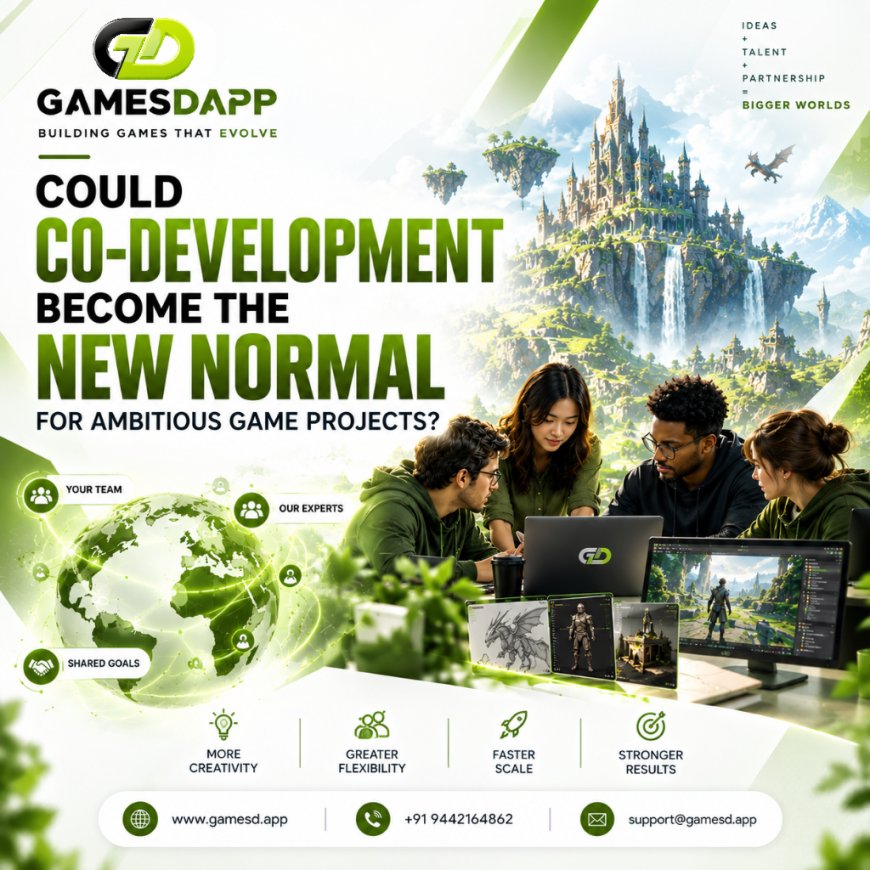
Making a big game is hard even with a strong team. The work often goes beyond one group’s skills. You may need better visuals, online multiplayer, game AI, updates after launch, and versions for several platforms. Players also expect more than before. When all of that lands at once, keeping everything in the house can get messy.

Because of that, many studios look at co-development. They do not simply swap out their team. Instead, they keep their own strengths and bring in outside help when they need extra hands or specific know how.
Why Are Game Projects Becoming Harder to Scale?
Players do not judge games by the main gameplay loop alone anymore. Many now look for clean graphics, smooth controls, multiplayer that feels solid, and updates that arrive on a steady pace. They also want social tools and good performance, not stutters or long load times. After release, they expect new stuff and tweaks, not silence.
To hit all of that, a team must cover more than just one skill. You need people who can handle game design and code. Work in 3D art and animation is also a must. Then there is AI work, multiplayer builds, cloud setup, QA testing, and ongoing LiveOps tasks.
For a smaller or fast growing studio, doing every part in-house can get heavy. Hiring can take longer, budgets grow, and schedules slip. That is why a flexible way to run production can end up as a real edge.
What Makes Co-Development Different?
Traditional outsourcing often involves assigning a specific task to an external vendor. Co-development takes a more integrated approach.
An external team works alongside the internal developers, sharing production responsibilities while following the project's creative direction, technical standards, and roadmap.
A game development company supporting a co-development project may contribute to feature development, game art, engineering, optimization, testing, or post-launch content without taking ownership away from the original studio.
This creates a hybrid structure where the internal team maintains strategic control while specialized teams expand production capacity.
When Does Co-Development Make the Most Sense?
Co-development becomes particularly useful when a project reaches a stage where internal resources become a bottleneck.
A studio may have a strong design team but require additional Unreal or Unity developers. Another may need more artists to complete a large environment pipeline or additional engineers to build multiplayer functionality.
Instead of delaying production while recruiting permanent employees, businesses can bring in specialized expertise for specific development phases.
This flexibility can be valuable for both established publishers and emerging studios trying to move ambitious concepts toward launch without overextending their core team.
What Does It Mean for Gamers?
For players, co-development is not about who sits in the development office. What matters is the quality of the final experience.
When additional specialists are integrated effectively, studios can potentially accelerate content production, improve technical quality, expand features, and respond faster to player feedback.
It can also support post-launch development. New characters, maps, events, gameplay modes, and seasonal content may require additional production capacity long after the original launch.
A scalable team structure can therefore contribute to a more consistent player experience over the game's lifecycle.
The Real Challenge: Managing Multiple Teams
Co-development does not work well just because you add more engineers.
Teams still have to align on shared docs, version control, and day to day communication. They also need agreed coding rules, clear asset workflows, and the same QA checks. Milestones have to be defined in plain terms.
If those basics are missing, bringing in an outside group can add friction. You may spend more time coordinating than making progress.
So companies should screen partners in a practical way. Look at their technical skill, past work, how they communicate, and how they run production. Also check if they can scale, handle security needs, and deliver solid QA. It helps when they have worked with teams that are not in the same place.
A good partner should blend into the team’s way of working. They should not feel like a separate vendor that only shows up at the end.
Could Co-Development Become the New Normal?
As game projects become larger and more specialized, the traditional idea of one studio handling every discipline internally may become less practical.
A hybrid model gives businesses the ability to keep creative leadership and critical product decisions in-house while accessing specialist capabilities when needed.
For the gaming industry, this could make co-development an increasingly common approach to managing production risk, scaling development teams, and responding to changing market demands.
How GamesDapp Can Support Co-Development
For businesses exploring a flexible production model, GamesDapp can serve as a potential co-development and game production partner.
Its capabilities across game development, game art, animation, multiplayer experiences, blockchain gaming, AI-powered gaming, and other specialized requirements can help businesses extend their existing teams based on project needs.
Instead of requiring businesses to build every capability internally, a specialized partner can provide additional production capacity while the core team remains focused on the game's vision, roadmap, and business strategy.
Conclusion
Co-development is not simply another form of outsourcing. It represents a more collaborative approach to building ambitious games by combining core teams, specialized expertise, and scalable production capacity.
For businesses, this can create greater flexibility as projects evolve. For developers, it can provide access to specialized talent. And for gamers, it can help studios deliver richer, more polished, and continuously evolving experiences.
As the complexity of game production continues to increase, the question may not be whether studios should build everything themselves, but which capabilities should remain core and where the right co-development partner can accelerate the journey from idea to successful game.